By Charlotte Pepping, Timothy Nguyen and Eva Fiona Schoener
Australia’s universities were built to serve the public. Now they’re slashing jobs, capping students, and chasing profits. So how did our higher education system end up looking more like big business than a place of learning?
Australia’s universities were considered the bastions of public goods – institutions that were grounded in scholarship, research, and public service. However, over the past few decades, this vision has slowly eroded due to various government policies and reforms. Today, many universities resemble corporate entities more than public institutions, specifically with a focus on branding, market competitiveness, and commercial output.
Governments and university leaders have gradually but deliberately transformed the system. Through government policy, changing funding models, and incentivising corporate-style management and steadily prioritising profits over academic freedom,
Now, with the government’s newly announced cap on international student enrolments at public universities. Staff and students are beginning to feel the long-term impacts of these shifts.
Cuts are the Symptom – The Real Crisis Runs Deeper
While the current wave of cuts appears to be sudden, there have been a growing number of academics saying that it is the result of decades-old transformation. University staff, students, and observers have highlighted that Australia is currently witnessing not only a funding crisis, but rather the result of a long, deliberate change: one that has pushed public institutions to operate more like business entities rather than centres of education and research.
From Scholarship to Survival
In the mid 19th century, Australian universities were elite institutions serving a small portion of the population – roughly 0.2 percent. They existed to teach and foster scholarship, rather than to generate revenue. Funding was scarce, and universities followed old laws, with oversight by state government and appointed councils. Most students relied upon Commonwealth scholarships, while state governments provided little to no direct financial support.
However, this model would not last.
In 1974, the Whitlam government made higher education free. His reforms were radical, as they removed tuition fees in a bid to make universities more accessible. However, entry was still restricted to those who met the academic criteria. Still, under the Whitlam government and his reforms, it represented a new direction for Australia’s education system as it symbolised a belief in education as a public good – a view that would soon be challenged.
How Universities Became Big Business
That philosophy shifted again in the 1980s, under the Hawke Labor government. Elected in 1983, Hawke introduced policies to expand access to university without increasing public spending. The government pushed universities to operate independently and find alternative revenue streams.
Jack Thrower, a research economist at the Australian Research Institute, said universities began to adopt commercial priorities during this time.
“They were encouraged to focus on these sorts of commercial outcomes – such as increasing revenue from international student numbers, generating commercial outputs, and maximising the prestige of the university,” Mr Thrower said.
“At the same time, there has been a shift away from seeing education as a public good towards these sorts of quasi corporate structures”.
Howard-era Reforms and Industrial Relations
This shift became more apparent under the Howard government in the late 1990s and early 2000s. Characterised as ‘an assault on the labour movement in Australia’s history’. The Howard government tried to change the Workplace Relations Act – targeting worker’s rights in sectors of the economy that have high rates of unionisation.
By restructuring employment relations, it would lead to the ‘marketisation’ of the universities. These amendments were designed to weaken unions. As a result, it would be detrimental to Australia’s tertiary education sector, as it restricted unions out of workplaces and restricted their involvement in enterprise bargaining.
The year 2003 marked a turning point as the Howard government imposed new conditions on funding tied to industrial relations reform. Through the Higher Education Workplace Relations Requirements (HEWRRs), universities were required to meet specific compliance measures in order to access additional federal funding – a move widely seen as an attempt to undermine the organising authority of the National Tertiary Education Union (NTEU).
Many academics and critics, at the time of these policies, were highly critical of how this academic enterprise had transformed universities into a business enterprise.
Dr Stuart Rosewarne, associate professor, states within their academic paper ‘Workplace “Reform” and the Restructuring of Higher Education’, that the reforms reshaped the role of university staff and diminished workplace protections.
“This has brought a change in attitudes towards staff who are not valued in the way they once were. Academic labour has been commodified and devalued. University governing bodies have been stripped of staff representatives”
Even now, Australian universities are still following the model and policies implemented under the Howard government. However, cracks within this out-dated model and poor accountability by university councils is beginning to become apparent, specifically after the COVID-19 pandemic, as mass staff cuts and millions of casual staff being underpaid, are direct examples of Australia’s faltering tertiary education system.
In addition to this, Australian universities have glaring weaknesses within their institutions. One of which is the university governance as they operate under the rules of the state governments – who have no interest or role in funding and performances. As a consequence, for poor governance. This has led to misconduct by university leadership in enrolment and research.
Lack of University Accountability and Senate Inquiry
Another issue is the control of universities and their appointment of university councils and senates – which is the equivalent of a board in business-like entities. These councils have little accountability and often act as figureheads, not real decision-makers.
Thrower said the sector operates in a “weird zone of unaccountability.”
“They’re not publicly accountable or privately accountable. We’ve seen a decline in the number of university councils who are elected by staff or students and a rise in the number that are just appointed for things such as financial expertise.”
After years of Australian universities being plagued with scandals, instances that include wage theft, conflict of interests, excessive spending on marketing, travel and consultants. There has been a recent senate inquiry on the quality of governance at the Australian higher education providers. The Senate of Education and Employment Legislation Committee launched an inquiry into university governance at Australian tertiary education providers on the 29th of January 2025.
This senate inquiry would be looking specifically at:
“Adequacy of the powers available to Tertiary Education Quality and Standards Agency to perform its role in identifying and addressing corporate governance issues, specifically:
Composition of providers’ governing bodies and the transparency, accountability, and effectiveness of their functions and processes – including in relation to expenditure, risk management, and conflict of interest.”
Although this senate inquiry is a first step into further shedding light on the various irregularities found in Australian universities. It still does not exclude the impending damages and repercussions in cutting hundreds of staff across Australia within the coming months where frustration is mounting.
Capping International Students: A Political Response to a Housing Crisis
Under a reclaimed Albanese government, many await to see the next steps to follow their announced plan to cap international student numbers at public universities to 145,000 annually. With the hope of this policy to boost housing availability and slash median prices.
The proposed policy has not come without controversy, with many calling out its deceptive truths. Andrew Hayen, Professor of Biostatistics at the UTS School of Public Health, noted, “I think it’s based on the fact that housing is a really hot political issue right now, and this policy [international student caps] is seen as a way to respond to that pressure.” For many academic professionals, including Andrew, this initiative is seen as a “simple, easy-to-implement measure” as opposed to pushing more complex policy changes and tax reform.
A Sector Already Under Strain
Australia’s tertiary education industry is no stranger to funding cuts. In the wake of COVID-19, universities saw international enrolments plummet, resulting in the loss of billions in revenue and in turn, thousands of staff. While the return of overseas students in recent years has offered financial relief, many institutions remain in a precarious position with political pressures, economic uncertainty, and a changing policy landscape.
UTS Takes Drastic Action to Close Deficit Gap
In light of this, many public institutions have been forced to look internally to address these funding gaps, including The University of Technology Sydney, who have announced they will be cutting a total of 400 jobs – 150 academic staff and 250 professional staff, effective as of the coming months. In their April Town Hall, UTS’s Chief Financial Officer Belinda Johnson announced the University’s “return back to surplus” plan. As of 2025, UTS is currently sitting at a deficit of 95 million. By 2026, this is expected to increase to a surplus of 5 million.
During the Town Hall, UTS’s Vice Chancellor, Andrew Parfitt shared with staff that since COVID the university has been running at an agreed deficit and that there is an urgent call to rectify this,
“We need to get our finances in shape, and that is hard…We are trying to do the minimum amount of damage in an environment where we have to reduce the amount we spend”.
Mr Parfitt has announced this period of job redundancies and restructuring within the university as one that does not come lightly to the institute, however necessary under the current circumstances. “The reality is, we have less scholars per student and a cap on non-domestic students and a bizarre circumstance externally where one of Australia’s most successful sectors is being trampled by both sides of politics.”
The Cost of “Efficiency”
Many working professionals within the sector fear that short-term solutions are taking precedence over long-term vision. For institutions built on public trust and intellectual inquiry, the current trajectory raises serious concerns about mission and sustainability.
“There’ll be fewer choices for students, and increased workloads for remaining staff. It’s difficult to see how cutting teaching staff and student support services could improve things. In any large organisation, there are always inefficiencies, sure – but when you’re cutting areas like teaching and support, it’s going to have a big effect.” – Andrew Hayen
Cuts Across the Country: A National Pattern
UTS is not the only Australian university to refocus its management in the wake of this national policy shift. In late 2024, the University of Melbourne announced an indefinite hiring freeze to address the projected $85 million loss of funds as a result of the international student cap.
Meanwhile, the Australian National University has publicly announced the institute’s $250 million deficit, with plans to have this debt wiped out by 2026. To meet these demands, the university has announced it will be slashing $100 million from staff salaries and $150 million in non-salary expenditure. The National Tertiary Education Union (NTEU) has estimated some 650 jobs will be impacted.
“A lot of the issue also comes back to a broader problem: the long-standing lack of proper government funding for universities, and that’s been an issue under both major parties for quite some time. International students have become a key way for universities to fund research because government support for research hasn’t been sufficient. Universities have become very reliant on them.” – Andrew Hayen
Vice-chancellor of Western Sydney University (WSU), George Williams, has addressed the greater impact of the proposed student cap for the institution, “We’ve been fighting very hard for a better outcome on international students. They make a massive contribution to Australia. We think they’re really important for our prosperity and community. And sadly, both the community loses by that policy, but also we do as well.”
For WSU, Mr Williams has shared his concern for the institute’s teaching and administrative facilities as he looks to the future.
“That’s [job cuts] something I feel a very heavy responsibility for and something I really wish we didn’t have to do. Otherwise, what we will do is we will really refocus on our mission. What’s most important to the university and for us as our students and community will be to make decisions based upon how we deliver for our students and community in the best possible way, and we’ll have to be a lean and more focused organisation. We have to live within our means.”
Executive Salaries Under Fire Amid Deepening Cuts
Vice-Chancellors, often described as the chief executives of Australia’s universities, are responsible for the strategic and financial direction of their institutions. But as staff face job losses and students see support services dwindle, many critics argue that these top roles are far too generously compensated, especially in an era of widespread austerity.
It’s not uncommon for a Vice-Chancellor to earn over $1 million AUD annually.
According to the Australia Institute, in 2022, the average Vice-Chancellor earned at least seven times more than a university lecturer and nine times more than a high school teacher. In fact, Vice-Chancellors at Australian universities are among the highest paid in the world. A 2023 comparison revealed that salaries at Australian institutions surpass those at elite global universities like Cambridge.
These pay packages have steadily risen over time. Between 1985 and 2023, the average Vice-Chancellor’s salary at Group of Eight (Go8) universities tripled, while the average full-time earnings of teaching staff grew by just under 40%. Student financial support has similarly lagged behind.
Unsurprisingly, this growing pay disparity leaves a bitter taste for many staff and students, especially as budget cuts continue to target frontline teaching and services.
Mr William understands this well,
“When I came in, I felt strongly that these salaries needed to be benchmarked against public sector norms. We’re a public institution serving the public good,” he said. “In my case, I’ve frozen my salary along with all senior leadership. When dealing with cuts, the impact should start at the top.”
WSU is currently facing an $80 million shortfall, and plans to cut 400 jobs in an effort to reduce costs. Williams says the university is also examining spending on maintenance, cleaning, consultants, and catering, with the aim of protecting the student experience as much as possible.
“We’re deliberately targeting savings in areas that won’t directly harm students. My hope is that—even as a leaner organisation—we’ll be more focused on student success.”
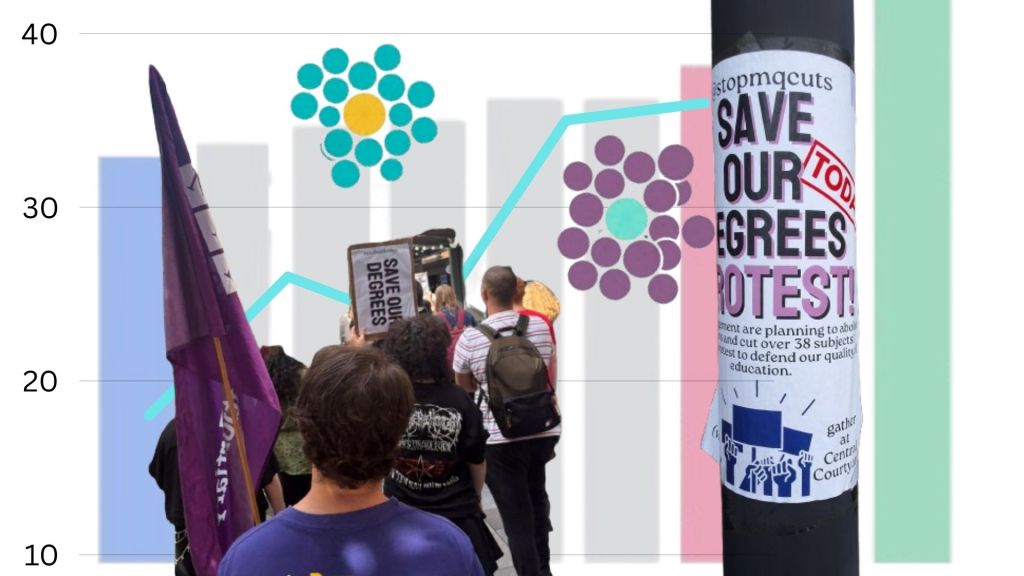
Despite those assurances, students across the country are feeling the impact. Activist groups at universities including UTS, Macquarie, and Wollongong have mobilised against the cuts, warning that a reduction in teaching staff inevitably leads to a drop in educational quality—the very thing students are paying increasingly high fees to access.
On the contrary, UTS lecturer Andrew Hayen provides an opposing lens to Vice-Chancellor George Williams. Where he believes that the politicisation and focus on Vice-Chancellor’s pay is more of a distraction that seeks to redirect the systemic issues, such as universities becoming more like business entities rather than educational public institutions.
“I think that’s right. It’s more of a distraction — something people can hide behind, in a sense. It’s not really the core problem.. I also think their salaries reflect the overall governance structure of universities. These days, university councils are dominated by corporate figures — people from big business rather than from education backgrounds. – Mr Hayden said.
“For example, our [UTS] Chancellor used to be the chair of the Commonwealth Bank. So I think the governance has shifted a lot, and that’s part of the problem too.”
A Sector at the Crossroads
The future of Australia’s higher education system appears increasingly precarious as universities continue to grapple with the ongoing fallout from decades of market-driven reforms. The combination of funding cuts, reliance on international student fees, and mounting political and economic pressures has placed institutions under immense strain. With job cuts, reduced student services, and skyrocketing executive salaries, the sector’s priorities seem to be shifting away from its foundational role of education and research towards a more business-oriented model.
The government’s proposed cap on international students is seen by many as a political ‘quick fix’, yet it fails to address the deeper issues plaguing the system, such as inadequate funding and poor governance.
While universities like Western Sydney and the University of Technology Sydney are taking drastic measures to balance budgets, the long-term implications on academic quality and staff wellbeing remain uncertain.
As frustrations grow among students and staff, the pressing question remains: how will Australia’s universities regain their balance and reaffirm their commitment to education as a public good, rather than just another market commodity? Without a radical shift in both policy and approach, the future of Australian higher education looks increasingly uncertain.
 Datastories by Fiona